
|
remember this day -- 26-Dec.-2004. tsunamis flooded coastlines between 15 minutes and 10 hours after the 2004 indian ocean earthquake, and killed 80,000 ppls (til 30-Dec-2004). |
Thursday, December 30, 2004
2004 Indian Ocean Earthquake.
Wednesday, December 29, 2004
Another social network for sharing photos
Again, there r so many social networks that make u boring. After months of life in the cyber-social world, many ppls may wonder what practical benefits can they bring. Here, at least, I suggest Flickr to u for photo sharing. I like so much that it is integrated with blogger seamlessly.
Ludicorp's Flickr, which could become a hot site, also has a function: sharing photos. It started with the basic idea: "What if we put live chat together with social networks and enabled people to share media with one another in real time?" Although this is already possible using instant messaging software and groupware sites such as Google Groups and Yahoo Groups, Flickr makes it far easier: the photos you want to share are in a "shoebox" along the bottom of the screen, and you send one by dropping the picture on a buddy's name.
Sharing photos online is likely to become more popular as more people buy digital cameras, and as cameras are built in to most mobile phones. Ludicorp's Eric Costello says the plan is to have photos uploaded automatically: We hope to have "watched folders", so if you drop a photo into a folder it will just show up in your shoebox. Also, we hope to integrate it with other photo sites, such as Ofoto, so you could pull in photos from there, or push photos there so you can have prints made of them."
A system that can be used to share photos can ultimately be adapted to share all sorts of things, and Flickr could obviously go much further. Ludicorp's Vancouver-based founder and president, Stewart Butterfield, says they're trying to build a system that supports relationships that transcend particular applications - instant messaging, email, Orkut etc.
For more information, check out flickr.com or the article introducing the above info.
Ludicorp's Flickr, which could become a hot site, also has a function: sharing photos. It started with the basic idea: "What if we put live chat together with social networks and enabled people to share media with one another in real time?" Although this is already possible using instant messaging software and groupware sites such as Google Groups and Yahoo Groups, Flickr makes it far easier: the photos you want to share are in a "shoebox" along the bottom of the screen, and you send one by dropping the picture on a buddy's name.
Sharing photos online is likely to become more popular as more people buy digital cameras, and as cameras are built in to most mobile phones. Ludicorp's Eric Costello says the plan is to have photos uploaded automatically: We hope to have "watched folders", so if you drop a photo into a folder it will just show up in your shoebox. Also, we hope to integrate it with other photo sites, such as Ofoto, so you could pull in photos from there, or push photos there so you can have prints made of them."
A system that can be used to share photos can ultimately be adapted to share all sorts of things, and Flickr could obviously go much further. Ludicorp's Vancouver-based founder and president, Stewart Butterfield, says they're trying to build a system that supports relationships that transcend particular applications - instant messaging, email, Orkut etc.
For more information, check out flickr.com or the article introducing the above info.
"KOI" - Japanese Ornamental Carp
koi (锦鲤; shortened from Japanese nishikigoi) are ornamental domesticated varieties of the common carp Cyprinus carpio.
s'pore develop its own farm model and s'porean visit farm just like visiting park.
last week, we visited singapore farmart. the pic is KOI in the mart, does it beautiful?

s'pore develop its own farm model and s'porean visit farm just like visiting park.
last week, we visited singapore farmart. the pic is KOI in the mart, does it beautiful?
Saturday, December 25, 2004
如何给BLOGGER加日历功能, a chinese version of how to add calendar in blogger
petersky说华人还有不鸟英文的, 那么用华文说也许可以帮多一些人, 这就是这个华文版的BLOGGER小帖士在这里的原因了.
我们知道BLOGGER不象LIVEJOURNAL什么的限制那么多, 基本可以配置一切可以想到的东西, 可是一个大问题是, BLOGGER竟然没有提供别家都有的日历功能, 其实给BLOGGER加一个日历(BLOGLENDAR)也很简单,我们只要做以下几步(当然首先要感谢一下MING HONG NG还有phil ringnalda, 他们基本把要做的都做了):
1、下载这个.tar.gz档, 解开共3个文件, 上载到你自己的主页上去。 我们假设你主页URL是http://zzz.com/, 这个三个文件的URL是http://zzz.com/bloglendar.js, http://zzz.com/bloglendar.css, http://zzz.com/bloglendar-main.js
2、 BLOGGER TEMPLATE大家应该都知道了咯,不多介绍,如果不了解, 推荐看一下这里。 好了, 第二步就是在你的TEMPLATE的head里面加入下面几行:
<script type='text/javascript' charset='<$BlogEncoding$>' src='http://zzz.com/bloglendar.js'>
</script> <script type='text/javascript' charset='<$BlogEncoding$>' src='http://zzz.com/bloglendar-main.js'>
</script> <link rel='stylesheet' type='text/css' href='http://zzz.com/bloglendar.css' />
3、第三步也许是最重要的一步了, 先解释一下BLOGGER TEMPLATE的一个小东西
a、 在TEMPLATE里面,大家应该可以找到这个一段(可能有点不同,慢慢找吧):
<BlogDateHeader>
<h2 class="date-header"><$BlogDateHeaderDate$></h2>
</BlogDateHeader>"
b、好了, 如果你的TEMPLATE有这几句,那么你如果你12月25日有一个POST,在HTML SOURCES里面,这个POST的日期就应该是这个样子:
<h2 class="date-header">december 25, 2004</h2><br/>
BLOGLENDAR所做的呢,就是把BLOGGER页面里上面这句找出来, 然后画一个日历, 然后把12.25给加亮显示出来。 问题是BLOGLENDAR的最早版本作者大概使用的template大概我们的不太一样(其实不是了,呵呵,不过这么比较好理解), 所以, 我们要做的第三步就是改改自己的TEMPLATE了, 把
<h2 class="date-header"><$BlogDateHeaderDate$></h2>改成<div class='blogDate' title='<$BlogDateHeaderDate$>'></div>就OK了。
4、在你想方日历的地方加入下面这句话:
我们知道BLOGGER不象LIVEJOURNAL什么的限制那么多, 基本可以配置一切可以想到的东西, 可是一个大问题是, BLOGGER竟然没有提供别家都有的日历功能, 其实给BLOGGER加一个日历(BLOGLENDAR)也很简单,我们只要做以下几步(当然首先要感谢一下MING HONG NG还有phil ringnalda, 他们基本把要做的都做了):
1、下载这个.tar.gz档, 解开共3个文件, 上载到你自己的主页上去。 我们假设你主页URL是http://zzz.com/, 这个三个文件的URL是http://zzz.com/bloglendar.js, http://zzz.com/bloglendar.css, http://zzz.com/bloglendar-main.js
2、 BLOGGER TEMPLATE大家应该都知道了咯,不多介绍,如果不了解, 推荐看一下这里。 好了, 第二步就是在你的TEMPLATE的head里面加入下面几行:
<script type='text/javascript' charset='<$BlogEncoding$>' src='http://zzz.com/bloglendar.js'>
</script> <script type='text/javascript' charset='<$BlogEncoding$>' src='http://zzz.com/bloglendar-main.js'>
</script> <link rel='stylesheet' type='text/css' href='http://zzz.com/bloglendar.css' />
3、第三步也许是最重要的一步了, 先解释一下BLOGGER TEMPLATE的一个小东西
a、 在TEMPLATE里面,大家应该可以找到这个一段(可能有点不同,慢慢找吧):
<BlogDateHeader>
<h2 class="date-header"><$BlogDateHeaderDate$></h2>
</BlogDateHeader>"
b、好了, 如果你的TEMPLATE有这几句,那么你如果你12月25日有一个POST,在HTML SOURCES里面,这个POST的日期就应该是这个样子:
<h2 class="date-header">december 25, 2004</h2><br/>
BLOGLENDAR所做的呢,就是把BLOGGER页面里上面这句找出来, 然后画一个日历, 然后把12.25给加亮显示出来。 问题是BLOGLENDAR的最早版本作者大概使用的template大概我们的不太一样(其实不是了,呵呵,不过这么比较好理解), 所以, 我们要做的第三步就是改改自己的TEMPLATE了, 把
<h2 class="date-header"><$BlogDateHeaderDate$></h2>改成<div class='blogDate' title='<$BlogDateHeaderDate$>'></div>就OK了。
4、在你想方日历的地方加入下面这句话:
<span id="bloglendar"><!-- Bloglendar here --></span>
Thursday, December 23, 2004
How to read them?
Always forget how to read them (the alphabet of greek letters, math symbols, etc), record here as reference:
| α
α Α β β Β γ γ Γ δ δ Δ ε ε Ε ζ ζ Ζ η η Η θ θ Θ ι ι Ι κ κ Κ λ λ Λ μ μ Μ ν ν Ν ο ο Ο ξ ξ Ξ π π Π ρ ρ Ρ σ σ Σ ς ς τ τ Τ υ υ Υ χ χ Χ ψ ψ Ψ φ φ Φ ω ω Ω ϑ ϑ ϒ ϒ ϖ ϖ |
´ ´ ∧ ∧ |
↔ ↔ |
Tuesday, December 21, 2004
KDE will talk to u!!
We know M$ has provided voice synthesis API for years. Many applications are built based on it. Although there r also many such kind of APIs on linux, they r relative difficult to install and config. Now, the good news is KDE will integrate Text-to-Speech (ktts) in its next important version -- KDE 4.
Another good news for linux is openoffice seems will announce its 2.0 soon, with access-like DBMS and better M$ compatible capability.
Another good news for linux is openoffice seems will announce its 2.0 soon, with access-like DBMS and better M$ compatible capability.
Sunday, December 12, 2004
Tips about shutdowning debian
It's easy to active shutdown option is kde logout menu, just use kdm as login manager and allow shutdown by normal users. Of cz, firstly, normal users must be capable to shutdown. unfortunately, it isn't default setting for debian.
I understand it's stupid for a server administrator to allow normal users to shutdown. But for desktop users, only be allowed to return to gdm or sudo everytime to shutdown is a stupid idea. To allow a normal user to shutdown, follow the following instruction:
Q: How do you give permission to shutdown(8) the machine to regular users?
Without patching the shutdown code to either link it to libpam or check your UID/GID, there are 2 simple ways.
Option 1: SUID ROOT
On debian, a distro which hates setuid root anything, /sbin/shutdown's default permissions are -rwxr-xr-x. If we make it setuid root
$ chmod u+s /sbin/shutdown (giving -rwsr-xr-x)
anyone and everyone can run /sbin/shutdown, and it will run as root. So everyone can shutdown the machine (ouch).
If we only want users from a special group to be able to execute it, we can just make it only executable by the owner and group
$ chmod g-wrx /sbin/shutdown (giving -rwsr-x---)
and then change the group owner to our special group. Debian has an adm group, which seems appropriate. (but we could just create a new shutdown, or wheel group of course).
$ chown root.adm /sbin/shutdown
-rwsr-x--- 1 root adm 16632 2002-05-28 12:27 /sbin/shutdown
So anyone we want to let shutdown the machine, we can just add to the adm group.
$ adduser fred adm
Options 2: sudo
If you use sudo, then
fred ALL=(root) /sbin/shutdown
in your sudoers file would let the user fred run shutdown as root. Without setuid root'ing anything! You can change "fred" for "%adm" or "%shutdown" to indicate a member of that %group.
sudo logs everything and doesn't need you to change any file permissions.
I guess the distro's that do allow anyone to shutdown the machine use setuid root binaries. Not as elegant as sudo, but they both work.
Gav
(ps, based on a conversation with Al)
I understand it's stupid for a server administrator to allow normal users to shutdown. But for desktop users, only be allowed to return to gdm or sudo everytime to shutdown is a stupid idea. To allow a normal user to shutdown, follow the following instruction:
Q: How do you give permission to shutdown(8) the machine to regular users?
Without patching the shutdown code to either link it to libpam or check your UID/GID, there are 2 simple ways.
Option 1: SUID ROOT
On debian, a distro which hates setuid root anything, /sbin/shutdown's default permissions are -rwxr-xr-x. If we make it setuid root
$ chmod u+s /sbin/shutdown (giving -rwsr-xr-x)
anyone and everyone can run /sbin/shutdown, and it will run as root. So everyone can shutdown the machine (ouch).
If we only want users from a special group to be able to execute it, we can just make it only executable by the owner and group
$ chmod g-wrx /sbin/shutdown (giving -rwsr-x---)
and then change the group owner to our special group. Debian has an adm group, which seems appropriate. (but we could just create a new shutdown, or wheel group of course).
$ chown root.adm /sbin/shutdown
-rwsr-x--- 1 root adm 16632 2002-05-28 12:27 /sbin/shutdown
So anyone we want to let shutdown the machine, we can just add to the adm group.
$ adduser fred adm
Options 2: sudo
If you use sudo, then
fred ALL=(root) /sbin/shutdown
in your sudoers file would let the user fred run shutdown as root. Without setuid root'ing anything! You can change "fred" for "%adm" or "%shutdown" to indicate a member of that %group.
sudo logs everything and doesn't need you to change any file permissions.
I guess the distro's that do allow anyone to shutdown the machine use setuid root binaries. Not as elegant as sudo, but they both work.
Gav
(ps, based on a conversation with Al)
Thursday, December 09, 2004
Wow, blog really in the view of researchers
See, a special issue from Communications of the ACM [ Volume 47 , Issue 12 (December 2004) The Blogospher ]
| SPECIAL ISSUE: The blogosphere | |||
| Introduction Andrew Rosenbloom Pages: 30 - 33 Full text available:  Html(11 KB), Html(11 KB), Pdf(56 KB) Pdf(56 KB)
| |||
| Structure and evolution of blogspace Ravi Kumar, Jasmine Novak, Prabhakar Raghavan, Andrew Tomkins Pages: 35 - 39 Full text available: Html(23 KB),Pdf(169 KB)
| |||
| Why we blog Bonnie A. Nardi, Diane J. Schiano, Michelle Gumbrecht, Luke Swartz Pages: 41 - 46 Full text available: Html(30 KB),Pdf(135 KB)
| |||
| Semantic blogging and decentralized knowledge management Steve Cayzer Pages: 47 - 52 Full text available: Html(28 KB),Pdf(148 KB)
| |||
| How blogging software reshapes the online community Rebecca Blood Pages: 53 - 55 Full text available: Html(15 KB),Pdf(62 KB)
| |||
| Democracy and filtering Cass R. Sunstein Pages: 57 - 59 Full text available: Html(14 KB),Pdf(56 KB)
| |||

Feedster New Feature --- customize search results icon about you
What's Feedster? OK. ------
Feedster is a rapidly growing news search engine that provides easy access to relevant and up-to-date information. Mainstream information providers, as well as hundreds of thousands of weblogs, are syndicating their information using a newly popular XML syndication standard called RSS (Really Simple Syndication). By combining professional journalism and individual commentary, Feedster is the first to utilize RSS and weblog content as a new format to enhance traditional news syndication. By filtering millions of specialized and continuously updated data sources...
That's good. Now feedster provides a new features that allow you to customize search results about you. One can claim that a search result is belong to him and then customize the contents returned by feedster: the icon, title, description, etc.
Read More...
Feedster is a rapidly growing news search engine that provides easy access to relevant and up-to-date information. Mainstream information providers, as well as hundreds of thousands of weblogs, are syndicating their information using a newly popular XML syndication standard called RSS (Really Simple Syndication). By combining professional journalism and individual commentary, Feedster is the first to utilize RSS and weblog content as a new format to enhance traditional news syndication. By filtering millions of specialized and continuously updated data sources...
That's good. Now feedster provides a new features that allow you to customize search results about you. One can claim that a search result is belong to him and then customize the contents returned by feedster: the icon, title, description, etc.
Read More...
Tuesday, December 07, 2004
Wallop, Hi5 or Orkut
I still remeber when lots of free email services began to appear online, everybody has lots of email accounts they will never check and even remember. Now, when social network services is brought by Google, M$, Hi5, etc., really boring to try them all and discarded some invitation. hehe. OK, anyway, I open a forum to ask/offer invitation from wallop, Gmail, orkut, Hi5, etc. Who are interested plz goto Link, Gmail, Wallop Exchange Place
Monday, December 06, 2004
2004 Phenomenon
You know you're living in 2004 when...
1. You accidentally enter your password on the microwave.
2. You haven't played solitaire with real cards in years.
3. You have a list of 15 phone numbers to reach your family of 3.
4. You e-mail the person who works at the desk next to you.
5. Your reason for not staying in touch with friends and family is that they don't have e-mail addresses.
6. You go home after a long day at work you still answer the phone in a business manner.
7. You make phone calls from home, you accidentally dial "9" to get an outside line.
8. You've sat at the same desk for four years and worked for three different companies.
10. You learn about your redundancy on the 11 o'clock news.
11. Your boss doesn't have the ability to do your job.
12. You pull up in your own driveway and use your cell phone to see if anyone is home.
13. Every commercial on television! h! ! as a website at the bottom of the screen.
14. Leaving the house without your cell phone, which you didn't have the first 20 or 30 (or 60) years of your life, is now a cause for panic and you turn around to go and get it.
15. You get up in the morning and go online before getting your coffee.
16. You start tilting your head sideways to smile. :)
17. You're reading this and nodding and laughing.
18. Even worse, you know exactly to whom you are going to forward this message.
19. You are too busy to notice there was no #9 on this list.
20. You actually scrolled back up to check that there wasn't a #9 on this list.
AND NOW U R LAUGHING at yourself.
1. You accidentally enter your password on the microwave.
2. You haven't played solitaire with real cards in years.
3. You have a list of 15 phone numbers to reach your family of 3.
4. You e-mail the person who works at the desk next to you.
5. Your reason for not staying in touch with friends and family is that they don't have e-mail addresses.
6. You go home after a long day at work you still answer the phone in a business manner.
7. You make phone calls from home, you accidentally dial "9" to get an outside line.
8. You've sat at the same desk for four years and worked for three different companies.
10. You learn about your redundancy on the 11 o'clock news.
11. Your boss doesn't have the ability to do your job.
12. You pull up in your own driveway and use your cell phone to see if anyone is home.
13. Every commercial on television! h! ! as a website at the bottom of the screen.
14. Leaving the house without your cell phone, which you didn't have the first 20 or 30 (or 60) years of your life, is now a cause for panic and you turn around to go and get it.
15. You get up in the morning and go online before getting your coffee.
16. You start tilting your head sideways to smile. :)
17. You're reading this and nodding and laughing.
18. Even worse, you know exactly to whom you are going to forward this message.
19. You are too busy to notice there was no #9 on this list.
20. You actually scrolled back up to check that there wasn't a #9 on this list.
AND NOW U R LAUGHING at yourself.
Thursday, December 02, 2004
My Parents' Gold Marriage!!!!!!!!!!
 My parents  |
As a present, a studio taken a set of photos to celebrate my parent's gold marriage. 50 years, it's really a marathon, right? hehe. Enough surprise, found my parents looks just like young people, although my father suffers from five kinds of heart disease and my mother is struggling to get away from threaten of diabetes |
 My father |
 mother |
Monday, November 29, 2004
Why not Linux
For all the woes suffered by Windows PC users, alternatives seldom get discussed. The assumption is that, with up to 95 percent of desktops running Windows, it's better to try to fix what's broke than to change horses altogether.
That attitude may be changing. In its December gift guide, Consumer Reports rated new Intel processors "unspectacular" and touted "59,940 reasons to reconsider Macs," including Apple Computer's increased support ratings at a time when satisfaction with desktop computers has declined dismally.
While Macs are getting more attention, another alternative ? Linux ? continues to be overlooked in Windows-dissatisfaction discussions. The reason: Reviewers typically don't run Linux boxes.
More...
More...
Tuesday, November 23, 2004
I am on the job marketing now
I am on the job marketing now. Although I will still be pursuing my Ph.D degree in the next half year, you must understand how difficult for a Ph.D to get a job and I must start now. :-), thus, i build a simple homepage here
Friday, November 19, 2004
wallop invitation federation
Wallop is a research project of the Social Computing Group at Microsoft Research, exploring how people share media and build conversations in the context of social networks. We are currently conducting a small, real world trial of Wallop with small friendship groups. Therefore, membership in Wallop is limited to study participants until the trial is over.
the above words are from M$'s website. doesn't it confused u what's wallop? hehe.
shortly, wallop is an online social networks (SN). it has some special features (especially, cool interface based on flash, on linux, must install the newest MS fonts, e.g. debian need the newest msttcorefonts) compared with other SN and has its own weakness.
just like gmail half year before, invitation quote to join wallop is a limited resource. i have no more wallop invitation now.
who have more and be generous to give out them? when i have more, i will give out too.
i open a wallop exchange board, who are interested plz post here.
cheers
Thursday, November 18, 2004
A man living in a cave.
I found I am really a man living in a cave and thick-witted to new techniques, and thus tend to losing creativity. :-D
I applied my first blogger account last year and forgot my account. I was invited to orkut half year ago and forgot what is it. I have the first gmail account until nobody want it. I read a paper without finding it's 3 years old.
As a technical (maybe science) man, such dullness maybe is not a good habbit. so i join wallop today to show i still can touch the frontier, and surprise to find, oh, my firefox cannot show text in wallop smoothly. :-D
I applied my first blogger account last year and forgot my account. I was invited to orkut half year ago and forgot what is it. I have the first gmail account until nobody want it. I read a paper without finding it's 3 years old.
As a technical (maybe science) man, such dullness maybe is not a good habbit. so i join wallop today to show i still can touch the frontier, and surprise to find, oh, my firefox cannot show text in wallop smoothly. :-D
Sunday, November 14, 2004
back to s'pore
arrived at s'pore last night. what a pity, had high fever today and lay in bed for almost whole day.
Monday, November 01, 2004
Hometown
I'll back to hometown (chang sha in the middle china) and visit parents in the coming vacation the day after tommorrow. Last time is December 2002, almost 2 years before. Donna know what changsha looks like now. Last weekend, there is a TV program from Taiwan introducing diet in changsha. I have totally no idea about the restaurants introduced. Now, I need to back to changsha and make up. :-D
Saturday, October 30, 2004
CHINESE MEDICINE MUTTON羊肉炉
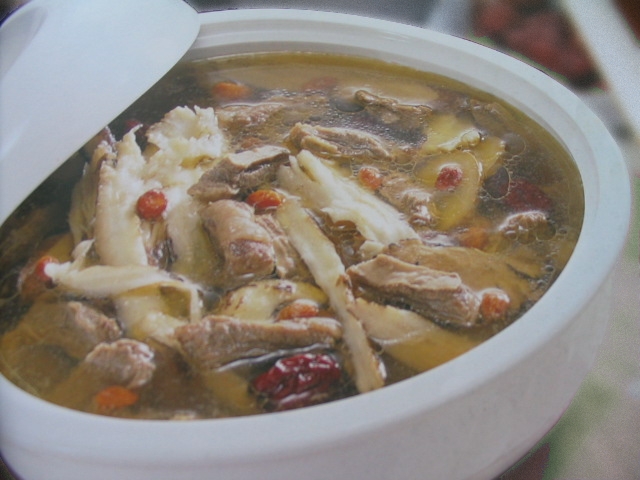 |
CHINESE MEDICINE MUTTON羊肉炉: 材料:羊肉500G, 老姜50G, 当归18G,桂枝,川芎,桂皮,黄芪,枸杞,红枣各15G (可去中药铺配齐) 工序:1。羊肉切块, 热水烫过,冷水冲, 桂枝入袋 2。老姜拍烂 3。其他材料洗净入锅煮1小时 |
Thursday, October 28, 2004
A Bovine Guide to Political Theory from The Utne Reader
From Roy Chan's blog
Feudalism: You have two cows. Your lord takes some of the milk.
Fascism: You have two cows. The government takes both, hires you to take care of them, and sells you the milk.
Pure socialism: You have two cows. The government takes them and puts them in a barn with everyone else’s cows. You have to take care of all the cows. The government gives you as much milk as you need.
Pure communism: You have two cows. Your neighbors help you take care of them, and you all share the milk.
Bureaucratic socialism: You have two cows. The government takes them and puts them in a barn with everyone else’s cows. They are cared for by ex-chicken farmers. You have to take care of the chickens the government took from the chicken farmers. The government gives you as much milk and as many eggs as the regulations say you should need.
Russian communism: You have two cows. You have to take care of them, but the government takes all the milk.
Pure democracy: You have two cows. Your neighbors decide who gets the milk.
Representative democracy: You have two cows. Your neighbors pick someone to tell you who gets the milk.
American democracy: The government promises to give you two cows if you vote for it. After the election, the president is impeached for speculating in cow futures.
Capitalism: You have two cows. You sell one and buy a bull.
Local governmental capitalism: The government condemns your cows under rights of eminent domain, knocks them over, and allows the mall to expand its parking lot.
Hong Kong capitalism: You have two cows. You sell three of them to your publicly listed company, using letters of credit opened by your brother-in-law at the bank ,then execute a debt-equity swap with associated general offer so that you get all four cows back, with a tax deduction for keeping five cows. The milk rights of six cows are transferred via a Panamanian intermediary to Cayman Islands company secretly owned by the majority shareholder who sells the rights to all seven cow’s milk back to the listed company. The annual report says that the company owns eight cows, with an option on one more. Meanwhile, you kill the two cows because the feng shui is bad.
Totalitarianism: You have two cows. The government takes them and denies they ever existed. Milk is banned.
Anarchism: You have two cows. Either you sell the milk at a fair price or your neighbors try to kill you and take the cows.
Dictatorship: You have two cows. The government takes both and shoots you.
Surrealism: You have two giraffes. The government requires you to take harmonica lessons.
How to call ocaml functions from C.
Here is an example of how to invoke a ocaml function from c codes.
/* str.c --- readin a string and format it as italy */
#include <stdio.h>
#include <caml/mlvalues.h>
#include <caml/callback.h>
int main (int argc,char **argv)
{
caml_main(argv);
if (argc>1)
printf( callback(*caml_named_value("format string"),copy_string(argv[1])));
return 0;
}
(* forstr.ml *)
let format_str (w:string) =
"<i>"^w^"</i>";;
Callback.register "format string" format_str;;
to compile as native format:
1. ocamlopt -output-obj forstr.ml -o forstring.o
2. gcc -c str.c /* cannot use g++ */
3. gcc -o test forstring.o str.o -L/usr/lib/ocaml/3.08/ -lasmrun -ldl -lm
/* str.c --- readin a string and format it as italy */
#include <stdio.h>
#include <caml/mlvalues.h>
#include <caml/callback.h>
int main (int argc,char **argv)
{
caml_main(argv);
if (argc>1)
printf( callback(*caml_named_value("format string"),copy_string(argv[1])));
return 0;
}
(* forstr.ml *)
let format_str (w:string) =
"<i>"^w^"</i>";;
Callback.register "format string" format_str;;
to compile as native format:
1. ocamlopt -output-obj forstr.ml -o forstring.o
2. gcc -c str.c /* cannot use g++ */
3. gcc -o test forstring.o str.o -L/usr/lib/ocaml/3.08/ -lasmrun -ldl -lm
Tuesday, October 26, 2004
How to get a free top-level domain name?
Tokelau brought a plan to introduce him on Web. OK, who is Tokelau? It's a small island (more several small islands?) country near New Zealand. I have never heard it several months before. The same goes on most people, I think. Now, their project to provide free .tk top-level domain name works.
To get your .tk name, plz:
To get your .tk name, plz:
- Goto its website and follow instruction to apply
- It will ask for a Ambassador coupon number, you can use 172818
Saturday, October 23, 2004
vedio under linux
It's not a happy experience to find all encoders to watch movies. even more, we know, media player won't play rm and realplay won't play wmv, as they are adversary. although i seldom watch movies on my linux box, i am still very happy to hear that there is no such boring issues if you installed xine and mplayer. The two players solves all.
actually, on fedora i only use mplayer, on debian i only use xine, and i have almost never need to consider where to grab encoders -- they can all be apt-gotten or downloaded from mplayers's homepage. i donno what's the underlying architecture of vedio players under linux, it's a bit strange that xine can use encoders provided by mplayer with a small trick. (just copy all encoders to /usr/lib/win32)
Wednesday, October 20, 2004
Debian
just replace fedora on my desktop and laptop with debian, as there are some debian mirrors in singapore and they are highspeed, with apt, to install debian is really a enjoyment. it's easy to config and easier to get various softwares, i love it.
Sunday, October 17, 2004
Chinese traditional medicine
| 芳 香化湿药 | 草
豆蔻(草蔻) 砂仁(缩砂
仁、阳春砂仁) 白豆蔻
(白蔻仁) 苍术 佩兰 藿香 |
|
温
化寒痰药
|
旋复花 白芥子 天南星 半夏 |
|
活
血祛瘀药
|
藏红花
(西红花) 桃仁 益母草
(坤草) 三棱 乳香 郁金
(玉金) 丹参(紫丹参) 刘寄奴 牛膝 (川牛膝、怀牛膝) 土鳖虫 虻虫 水蛭 王不留 皂角刺 穿山甲 (山甲珠) 酸枣仁 元胡 (玄胡、延胡索) 苏木 五灵脂 红花 (南红花) 泽兰 莪术 没药 姜黄 鸡血藤 紫参 (石见穿、石打穿) 川芎 珍珠母 |
|
清
热燥湿药
|
伸筋草
海桐皮 五加皮
白花蛇 桑寄生
千年健 络石藤
海风藤 xi莶 草 木瓜 秦艽 威灵仙 黄连 (川连) 黄芩 |
|
利水渗湿药
|
路路通 石苇 海金沙 地肤子 冬葵子 bian
蓄 冬瓜皮 木通 滑石 车前子 泽泻 茯苓 赤小豆 金钱草 萆xie 瞿麦 通草 薏苡仁 (苡仁米) 大腹皮 茵陈 (茵陈蒿) 猪苓 防己 葫 芦(抽葫芦) |
|
消
化热痰药
|
海藻
昆布 海浮石
胖大海 竹茹
天竺黄 贝母
(浙贝母、川贝母) 瓜蒌(全瓜蒌、括蒌) |
|
重镇安神药
|
紫贝齿 磁石 (灵磁石) 琥珀 朱砂 (辰砂) |
|
辛凉解表药
|
木贼草
淡豆豉 升麻
浮萍 蔓荆子
蝉蜕
(蝉衣) 牛蒡子 薄荷
菊花 桑叶 葛根 柴胡 |
|
平肝熄风药
|
羚羊角 代赭石 龙骨 地龙
(蚯蚓) 白蒺藜
(刺蒺藜) 僵蚕 天麻 石决明 牡蛎 蜈蚣 地龙 (蚯蚓) 全蝎(全虫) 僵蚕 |
|
止咳平喘药
|
知母
木蝴蝶
(玉蝴蝶、千张纸) 海蛤壳 葶苈子
马兜铃 枇杷叶
百部 款冬花 (冬花) 紫菀 桔梗 白前 杏仁 |
|
养心安神药
|
灵芝 (赤灵芝) 夜交藤(首乌藤) 合欢皮 远志 柏子仁 |
|
清热泻火药
|
罗布麻
芦根
(苇茎) 竹叶 夏枯草
夜明砂 密蒙花
谷精草 决明子 (草决明) 石膏 |
|
润下药
|
郁李仁 大麻仁 (火麻仁) |
| 攻 下 药 | 番泻叶 芒硝 大黄 (川军、锦纹) |
|
补阴药
|
玄参
(元参) 桑椹 鳖甲 龟板 山茱萸
(山萸肉) 潼蒺藜(沙苑蒺藜) 旱莲草 女贞子 枸杞子 蜂蜜 玉竹 (葳蕤) 百合 石斛 天冬 麦冬 (寸冬) 沙参(南沙参、北沙参) |
|
止血药
|
伏龙肝
(灶心土) 蒲黄 花蕊石
棕榈炭
(陈棕炭) 血余炭 白茅根 侧柏叶 槐花 地榆 茜草 小蓟 (刺儿菜) 大蓟 白芨 三七 (人参三七) 仙鹤草 苎麻根 |
|
驱虫药
|
贯众 雷丸 槟榔 芜荑 鹤虱 苦楝根 皮 南瓜子 榧子 |
|
补血药
|
紫河车
(胎盘) 何首乌 阿胶
(阿胶珠) 龙眼肉(桂元肉) 白芍 (杭芍) 当归 熟地黄 (熟地) |
|
温里药
|
|
|
理气药
|
乌药
(台乌药) 刀豆子 柿蒂 降香 沉香 绿萼梅 佛手 香橼 檀香 香附 厚朴 枳实 川楝子(金铃子) 木香 (广木香) 荔枝核 青皮 薤白 陈皮 (橘皮) |
| 补 气药 | 扁豆
白术 山药
(薯蓣) 太子参(孩儿参、童参) 党参
西洋参 人参 甘草 大枣 (红枣) 黄精 黄芪 |
|
清导药
|
莱菔子 鸡内金 山楂 谷芽 (稻芽) 麦芽 神曲 (建曲) |
|
其它药
|
蟾酥
马钱子
(番木鳖) 硼砂(月石) 炉甘石
明矾
(白矾) 蛇床子 血竭 硫磺 |
|
助阳药
|
续断
(川断) 狗脊 杜仲
冬虫夏
草 仙灵脾(淫羊藿) 仙茅
益智仁 葫芦巴 补骨脂 (破故纸) 胡桃肉 (核桃仁) 巴戟天(巴戟肉) 肉苁蓉 (淡大云) 鹿角霜 鹿角胶 鹿角 鹿茸 韭菜子 锁阳 蛤蚧 菟丝子 |
|
辛温解表药
|
名称
香薷 生姜
辛荑 苍耳子
细辛 藁本
白芷 防风
荆芥 桂枝 苏叶 麻黄 |
| 清热解毒药 | 虎杖
锦灯笼 青果
(橄榄) 马勃 射干
山豆根 土茯苓
白藓皮 红藤 半边莲 龙葵 漏芦 白花蛇 舌草 穿心莲 山慈菇 马齿苋 白头翁 败酱草 蚤休 (草河车、七叶一枝花) 鱼腥草 紫花地丁 蒲公英 (黄花地丁) 板蓝根 连翘 金银花 (银花、双花、忍冬花) 半枝莲 |
|
芳香开窍药
|
麝香 苏合香 菖蒲 (石菖蒲) 牛黄 冰片 (梅片) |
|
逐水药
|
使君子 大戟 芫花 甘遂 牵牛子 (黑白丑、二丑) |
|
固涩药
|
诃子
(诃黎勒) 鸡冠花 白果
(银杏) 乌贼骨(海螵蛸) 莲子
(莲肉) 石榴皮 米壳 (罂粟壳) 肉豆蔻(肉果) 禹余粮 赤石脂 金樱子 芡实 复盆子 桑螵蛸 五倍子 五味子 乌梅 麻黄根 浮小麦 |
Thursday, October 14, 2004
Another blogger tool (i like it)
Do you know PyQlogger? I found it at kde-apps.org just now.
PyQlogger is based on python, u can see from its name.
After disappointed by those blogger clients that cannot edit post title, pyqlogger appears finally.
It even can save posts as local draft copies.
Seems it have some bugs, maybe only on my box. Check out here.
WebLog Madness and hereis a very complete list of blog related stuffs.
Sunday, October 10, 2004
Tips about Blogger Archives -- drop-down menu and calendar
The calendar introduced in this article is based on client javascript, I also implement a Web service to generate calendar for you. Please check out at BlogCat, and its tutorial, the Web service is more comprehensive than the javascript version. If you donnot mind to try, you will like it.
For those 'elder' bloggers, archive lists may take up almost whole sidebar. Organizing the archive list in a drop-down menu is a good choice. It's simple, just place the following scripts in your blogger template:
Check out the result effect in my right panel. Before introducing bloglendar, Here is a php-based blog calendar prototype, if you are interested, please check out.
Bloglender is a script add a calendar to blogger, while we know blogger does not provide native calendar like MT, WordProcess. Its idea is simple:
For those 'elder' bloggers, archive lists may take up almost whole sidebar. Organizing the archive list in a drop-down menu is a good choice. It's simple, just place the following scripts in your blogger template:
<select name="ArchiveMenu"
onChange="location.href=this.options[this.selectedIndex].value;">

<option value="/">-------------------</option>

<BloggerArchives>

<option
value="<$BlogArchiveURL$>">------<$BlogArchiveName$>------</option>

</BloggerArchives>

<option value="/">Current Posts</option>

</select>
Check out the result effect in my right panel. Before introducing bloglendar, Here is a php-based blog calendar prototype, if you are interested, please check out.
Bloglender is a script add a calendar to blogger, while we know blogger does not provide native calendar like MT, WordProcess. Its idea is simple:
- assign a special class to DateHeader of ur blog
- draw a calendar of current month
- read in all elements of DataHeader class, add a hyperlink in the calendar corresponding to each DataHeader element
- copy three script files to ur server,
- add the following codes to ur template:
<script type="text/javascript" charset="<$BlogEncoding$>" src="[your_server]/bloglendar.js">
</script> <script type="text/javascript" charset="<$BlogEncoding$>" src="[your_server]/bloglendar-main.js">
</script> <link rel="stylesheet" type="text/css" href="[your_server]/bloglendar.css" /> - enclose ur BlogDataHeader in a DIV element with class "blogDate", e.g.:
<BlogDateHeader>
<div class="blogDate" title="<$BlogDateHeaderDate$>"></div>
</BlogDateHeader> - insert the below line to where u want the calendar appears:
<span id="bloglendar"><!-- Bloglendar here --></span>
Friday, October 08, 2004
3D Desktop!
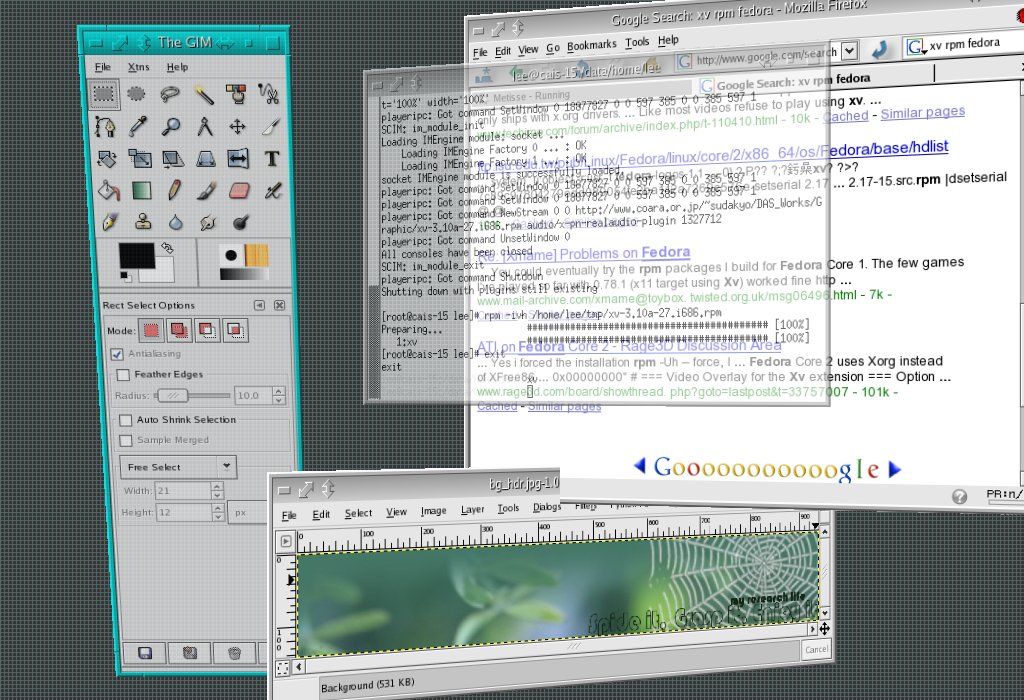 |
these days, here is more like a photo blog due to lack of time to write anything patiently. so, just take photos, copy screens. anyway, the screen copy left is really cute. It's Metisse, an experimental X desktop with some OpenGL capacity. It is constituted by a virtual X server called Xwnc, a special version of FVWM and an FVWM module FvwmAmetista (after Ametista). I'd think Thomas Chung introduces it at fedoranews |
wow, my 3D! Desktop

Wednesday, September 29, 2004
Lanterns of the Mid-autumn Festival. Chinatown, Singapore

lanterns of the Mid-autumn Festival. Chinatown, Singapore
Tuesday, September 28, 2004
Job Hunting
As I will be on the job market soon, here is some job sites recommended by my GF.
Sunday, September 26, 2004
Tips: Categorize Blogger Posts
Before read this article, I need to tell you that I have implemented a Web services to generate cateogry list for blogger. You can check out at BlogCat, which is easier to maintain than the method introduced in the following paragraphs.
This article give a tip to categorize ur posts. With tricks given, u only need to add several words in ur posts to put them into a certain category. And then, following a hyperlink, u can list all posts of a category.
Before you read this post, plz refer to another post, which bring a idea to categorize ur blogger archives. Its basic idea is to:
This article give a tip to categorize ur posts. With tricks given, u only need to add several words in ur posts to put them into a certain category. And then, following a hyperlink, u can list all posts of a category.
Before you read this post, plz refer to another post, which bring a idea to categorize ur blogger archives. Its basic idea is to:
- generate a permanent link for each post on blogger, actually, this is the default action of most blogger template
- build some category pages that list those permanent links.
- plz confirm whether u have generate a permanent link for each post, if no, plz follow this post to generate them.
- add a site search for ur blogger. I know google is the choice for most ppls, here, i recommend PICO, as i am using it. Why to use PICO? As it can index ur website when you need, and no need to wait several months for google reindexing. U donna know what's PICO site search? plz visit its homepage. :-), or try the sample in my right panel. its codes are:
<FORM METHOD="GET"
ACTION="http://www.picosearch.com/cgi-bin/ts.pl">
<INPUT TYPE="HIDDEN" NAME="index" VALUE="223786">
<TABLE CELLSPACING=0 CELLPADDING=0 BORDER=0><TR><TD>
<TABLE CELLSPACING=2 CELLPADDING=0 BORDER=0>
<TR>
<TD colspan="2"><A HREF="http://www.picosearch.com/cgi-bin/index.pl?wherefrom=picobox&type=all" TARGET="_blank">
<IMG BORDER="0" SRC="http://www.picosearch.com/picosmall.gif" ALT="PicoSearch"></A>
<INPUT TYPE="TEXT" NAME="query" VALUE="" SIZE="19"></TD>
</TR>
<TR>
<TD>
<INPUT TYPE="SUBMIT" VALUE="Go" name="SEARCH">
</TD><TD ALIGN=RIGHT><SELECT NAME="opt"><OPTION SELECTED VALUE="ANY">Find ANY word <OPTION VALUE="ALL">Find ALL words <OPTION VALUE="EXACT">Find EXACT phrase</SELECT></TD></TR>
<tr><td><FONT SIZE=-2><A HREF="http://www.picosearch.com/cgi-bin/ts.pl?index=223786&help=help" >Help </A></FONT></td><td align=right><font size=-2><a href="http://www.picosearch.com/cgi-bin/index.pl?wherefrom=picobox&type=all" target=_blank>Site Search by PicoSearch</a></font></td></tr>
</TABLE></TD></TR></TABLE></FORM> - add a form to ur blogger template:
<form METHOD="GET"
ACTION="http://www.picosearch.com/cgi-bin/ts.pl">
<INPUT TYPE="HIDDEN" NAME="index" VALUE="223786">
<INPUT TYPE="HIDDEN" NAME="opt" VALUE="ALL">
<SELECT NAME="query" width="100"><OPTION SELECTED VALUE="xxxxx Category-Research">Research
<OPTION VALUE="xxxxx Category-Life">Life</SELECT>
<INPUT TYPE="SUBMIT" VALUE="List Posts" name="SEARCH">
</form> plz replace the index INPUT value with ur own value. Mine is 223786. Your can find it in the FORM codes given by PICO. Here, i build two categories in my blogger --- "Research" and "Life". The pith is coming. :-) plz set the value of the select input's value to some words corresponding to categories. Corresponding to research category, I set the value to "xxxxx Category-Research", where xxxxx is a word (or phrase) appearing in pemanent posts only. (I use xxxxx here is because if I use the real phrase i am using, this post will taint my category.) To life category, i set it to "xxxxx Category-Life". - add the word "Category-Research" to the post, anywhere u want. Then, it is categorized to "Research" category.
- reindex ur pico
Wednesday, September 22, 2004
[ResearchRec]: Books read and Online Resources
Some book won't give me any appetite to have. Reversely, I cannot help buying and placing some books on my shelf. Maybe you are interested in them, maybe not. Check out what I read and some online resources I like, leave your comments if you like them too.

- Automata, Language, Logic
- Introduction to Automata Theory, Languages, and Computation: brought by John E. Hopcroft, Rajeev Motwani and Jeffrey D. Ullman. It's one of my textbooks in Southeast Univ. The most comprehensive one for both beginners and researhers.
- Formal Syntax and Semantics of Programming Languages: from Ken Slonneger. I found it just now, here is its eversion. Seems interesting.
- Introduction to Functional Programming by John Harrison, actually it's a lecture notes. this is the best one i have seen that explains how to move from lambda calcus to ML in a so simple way.
Monday, September 20, 2004
Linux Software
I found there are so many excellent tools on linux, however, always forgotten by me time and time again. So, I start this page to record my favorite tools.
- Document Reader
- CHM files: KChmPart plugin for konqueror, xchm (the only one i found print feature, still weaker than MS), gnochm.
- MHT files: MAF plugin for firefox is good to open and save .MAF and .MHT files, unfortunately, it is only compatible with itself (not with MS). kmhtconvert is a tool convert mht to format understanded by konqueror, still in beta status.
- PDF files: lots tools to read PDF files. pstill can concat multiple pdf files, extract pages from pdf, etc. It is free for educational purpose.
- System Tools
- GMailFS: We all know gmail provide 1G to each user, can u imagine how to use the 1G space? huh, mount it as a local hardisk? Here it is.
- Document Editor
- HTML editor: everybody may know quanta, there is a lighter WYSISWYG editor nvu
- Entertainment
- Video Player: MPlayer is a movie player for Linux (runs on many other Unices, and non-x86 CPUs), Windows, Mac OS X. It plays most MPEG, VOB, AVI, OGG/OGM, VIVO, ASF/WMA/WMV, QT/MOV/MP4, FLI, RM, NuppelVideo, YUV4MPEG, FILM, RoQ, PVA files, supported by many native, XAnim, and Win32 DLL codecs. You can watch VideoCD, SVCD, DVD, 3ivx, DivX 3/4/5 and even WMV movies, too (without the avifile library). PS: must known, debian does not provide official repositories for mplayer for some reasons i donno know. It's OK, here is a repository you can find mplayer for debian:
deb ftp://ftp.nerim.net/debian-marillat/ unstable main
To record streaming media get a URL of a stream and use command line strings like in the following examples:mplayer.exe -dumpstream URLAfter recording you will get the file stream.dump. You should rename it to .rm, .ra, .asf, .wmv or other format you are using. MPlayer supports HTTP, RTSP, MMS protocols to record Windows Media, RealVideo/RealAudio, QuickTime Video Recommended free MPlayer package with GUI for Windows: MPlayer + frontend by Gabor Szecsi (When using it enter your URL in a Media file editbox and "-dumpstream" (without quotes) in MPlayer Extra parameters editbox, then click "Start" button to start recording process). For other tools, plz read here.
- Video Player: MPlayer is a movie player for Linux (runs on many other Unices, and non-x86 CPUs), Windows, Mac OS X. It plays most MPEG, VOB, AVI, OGG/OGM, VIVO, ASF/WMA/WMV, QT/MOV/MP4, FLI, RM, NuppelVideo, YUV4MPEG, FILM, RoQ, PVA files, supported by many native, XAnim, and Win32 DLL codecs. You can watch VideoCD, SVCD, DVD, 3ivx, DivX 3/4/5 and even WMV movies, too (without the avifile library). PS: must known, debian does not provide official repositories for mplayer for some reasons i donno know. It's OK, here is a repository you can find mplayer for debian:
- Anti-Virus
-
so far, i do not know who care anti-virus software on linux, although i download one just now: f-prot
- Miscs
- springgraph, graphviz: Springgraph is a small tool that will read in a .dot file description of a graph, which, for each node, specifies its name and which other nodes it is connected to, and then renders a graph; e.g., apt-rdepends -d springgraph >1.dot; springgraph <1.dot>1.png; will generate dependence graph of springgraph binary package. Graphviz is much more comprehensive than springgraph, and generated graph is more beautiful.
- Graphic Editor
- IPE: Ipe is a drawing editor for creating figures in PDF or (encapsulated) Postscript format. It supports making small figures for inclusion into LaTeX-documents as well as making multi-page PDF presentations that can be shown on-line with Acrobat Reader. So, what's the difference between IPE and xfig? I love IPE much, as it integrate latex macros seamlessly, which means u can draw tables, write formula in a convenient way (which cannot be done by xifg so far, i think).
- QtiPlot: I used it to do my thesis graphs
- More...更多
- Must know, none of them has no weakness, e.g. IPE cannot import eps and pre-defined items. Another problem is although most of them can export to eps/pdf, they cannot import eps and pdf with fine effect. To combine them is a good choice, pstoedit is such a good util that can convert eps/pdf to vector format (xfig, dia, etc.) that can be used to do this.
- Development
- gnome source navigator: have similar features as source insight on windows, of cz, it is totally free. u can also get all reference of a function, what the function refers to, etc.
- A quite old windows alternative software table: The table of equivalents / replacements / analogs of Windows software in Linux.
Saturday, September 18, 2004
[ResearchRec]: PageRank
Before getting pagerank ranking improvement, it's important to understand it. Of cz, it's elegant from math perspective, like HITS. Actually, it's also quite straightforward from practical perspectives. Here is an article giving some examples to explain PageRank.
Surprisely, there even exists forums focus on how to improve PageRank. Unfortunately, many people argues that google is lagging behind the changing of internet (e.g., blog is changing the internet, :-d), like yahoo!, altavista was. Here is some discussions. Concisely, I think they mean:
Surprisely, there even exists forums focus on how to improve PageRank. Unfortunately, many people argues that google is lagging behind the changing of internet (e.g., blog is changing the internet, :-d), like yahoo!, altavista was. Here is some discussions. Concisely, I think they mean:
- a principle property of blogs is that they are full of hyerlinks.
- hyperlinks in blog may "taint" google's search results from perpspective of sellers and ads.
- google must consider more about money then rank solely "popular" and adjust its PageRank.
- of cz, the adjusted pagerank is not the pagerank we known, thus, pagerank is dead, they concluded.
Thursday, September 16, 2004
[ResearchRec]: Approximation algorithm
From Wikipedia, the free encyclopedia.
In computer science, approximation algorithms are an approach to attacking NP-hard optimization problems. Since it is unlikely that there can ever be efficient exact algorithms solving NP-hard problems, one settles for non-optimal solutions, but requires them to be found in polynomial time. Unlike heuristics, which just usually find reasonable good solutions reasonably fast, one wants provable solution quality and provable run time bounds. Ideally, the approximation is optimal up to a small constant factor (say 5%).
In computer science, approximation algorithms are an approach to attacking NP-hard optimization problems. Since it is unlikely that there can ever be efficient exact algorithms solving NP-hard problems, one settles for non-optimal solutions, but requires them to be found in polynomial time. Unlike heuristics, which just usually find reasonable good solutions reasonably fast, one wants provable solution quality and provable run time bounds. Ideally, the approximation is optimal up to a small constant factor (say 5%).
NP-hard problems vary greatly in their approximatibility; some can be approximated to arbitrary factors (such approximation algorithms are often called polynomial time approximation schemes or PTAS), some can essentially not be approximated at all.
A typical example for an approximation algorithm is the one for Vertex Cover: Find an uncovered edge and take both end points into the vertex cover. Clearly, this can only yield a set up to two times larger than the optimal one.
Frequently, one can gain approximation algorithms from examining relaxed linear programs.
Not all approximation algorithms are suitable for practical application. For example, most people would not be impressed by a scheme which provably will require them to spend less than twenty times the money that is minimally needed. Also, for some approximation algorithms, the polynomial run time can be quite bad, like O(n2000).
Another limitation of the approach is that it applies only to optimization problems and not to “pure” decision
problems like Satisfiability.
A compendium of NP optimization problems
Wednesday, September 15, 2004


[LifeRec]: Diary cartoon, enjoy it...
Here is some comics updated dialy. If you want to use them, please follow hyperlinks and contact with authors. If you, the owner, do not want them to appear here, leave me a message and i will remove them.

 Today's Squinker
Today's Mark
More...
Today's Squinker
Today's Mark
More...


Tuesday, September 14, 2004
Discussion about XML model
Some discussion
Another related interesting result is: polynomial time decidability of constraints for the ER model - this work is titled "On the Interaction between ISA and Cardinality Constraints" by D. Calvanese and M. Lenzerini, and appeared in ICDE 94. The main things about the 3 works are: 1. Henry Thompson showed that given a DTD, to check whether there is a valid instance is NP complete. It is definitely in NP, and henry showed it is NP Hard by reduction from 3SAT. 2. The work by Wenfei Fan et al, show that if we have keys and foreign keys specified as path expressions, then whether there is a valid instance that satisfies both the DTD and the constraints is undecidable (note: this is different from NPC). Note at the same time, for relational model, whether there is a valid instance for a given relational schema is trivially true. There is another result: For the relational model, whether a key is implied by a given set of keys and foreign keys is undecidable. 3. The work in ICDE 94 shows that given a ER model, whether there is a valid instance is polynomially decidable, this is true even in the presence of ISA constraints. They further show that whether a cardinality is implied by a set of ISA and cardinality constraints is decidable in polynomial time. My two cents worth: 3) is very promising. I would argue that we should design XML models so that it conforms to 3). I have tried to base our work on that - the work i pointed about constraint specification. I am not sure of the significance of trying to answer whether a key is implied by a given set of keys and foreign keys, which is undecidable even for the relational model. If you see Henry's result 1) it definitely does not conform to ER at all. More work needs to be done with respect to constraint specification. cheers and regards - murali. On XML Integrity Constraints in the Presence of DTDs Journal of the ACM (JACM), Volume 49 , Issue 3, pp 368 - 406, May 2002. Wenfei Fan and Leonid Libkin http://www.bell-labs.com/user/wenfei/papers/jacm.pdf That article should be read with care: it talks of DTDs but it means grammars in general, and it talks of integrity constraints, but these are not ID/IDREF. Thus it seems that they share the same proviso as with Henry's analysis: Henry's analysis seems to apply to DTDs with fixed IDs or fixed IDREFs, and this paper applies to where there is an outside fixed set of constraints such as keys and foreign keys. Cheers Rick Jelliffe
Another related interesting result is: polynomial time decidability of constraints for the ER model - this work is titled "On the Interaction between ISA and Cardinality Constraints" by D. Calvanese and M. Lenzerini, and appeared in ICDE 94. The main things about the 3 works are: 1. Henry Thompson showed that given a DTD, to check whether there is a valid instance is NP complete. It is definitely in NP, and henry showed it is NP Hard by reduction from 3SAT. 2. The work by Wenfei Fan et al, show that if we have keys and foreign keys specified as path expressions, then whether there is a valid instance that satisfies both the DTD and the constraints is undecidable (note: this is different from NPC). Note at the same time, for relational model, whether there is a valid instance for a given relational schema is trivially true. There is another result: For the relational model, whether a key is implied by a given set of keys and foreign keys is undecidable. 3. The work in ICDE 94 shows that given a ER model, whether there is a valid instance is polynomially decidable, this is true even in the presence of ISA constraints. They further show that whether a cardinality is implied by a set of ISA and cardinality constraints is decidable in polynomial time. My two cents worth: 3) is very promising. I would argue that we should design XML models so that it conforms to 3). I have tried to base our work on that - the work i pointed about constraint specification. I am not sure of the significance of trying to answer whether a key is implied by a given set of keys and foreign keys, which is undecidable even for the relational model. If you see Henry's result 1) it definitely does not conform to ER at all. More work needs to be done with respect to constraint specification. cheers and regards - murali. On XML Integrity Constraints in the Presence of DTDs Journal of the ACM (JACM), Volume 49 , Issue 3, pp 368 - 406, May 2002. Wenfei Fan and Leonid Libkin http://www.bell-labs.com/user/wenfei/papers/jacm.pdf That article should be read with care: it talks of DTDs but it means grammars in general, and it talks of integrity constraints, but these are not ID/IDREF. Thus it seems that they share the same proviso as with Henry's analysis: Henry's analysis seems to apply to DTDs with fixed IDs or fixed IDREFs, and this paper applies to where there is an outside fixed set of constraints such as keys and foreign keys. Cheers Rick Jelliffe